

Chilean quince paste (dulce de membrillo): easy step-by-step recipe
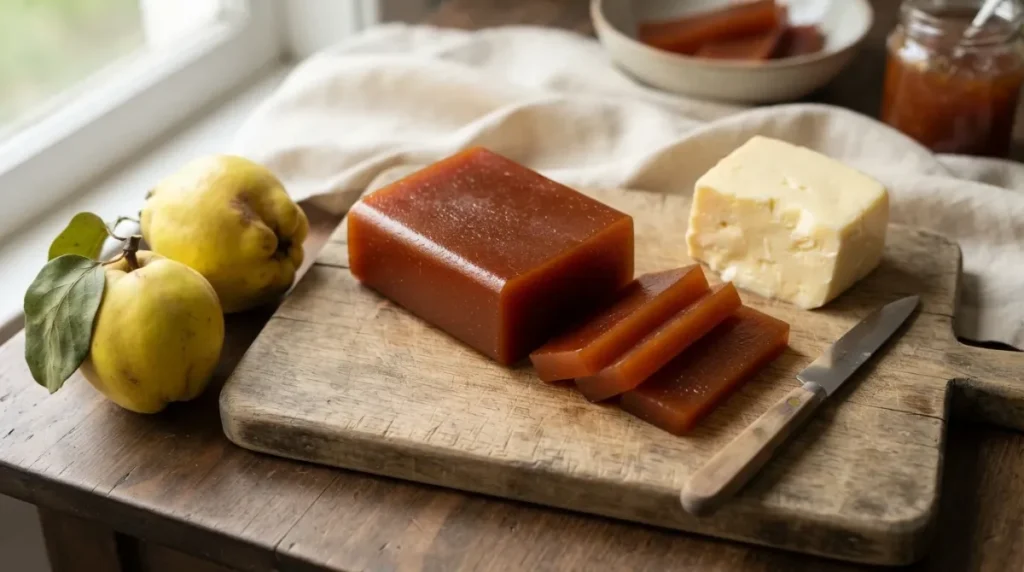
Dulce de membrillo is a firm paste of quince fruit cooked with sugar until it sets enough to slice. In Chile it is a fixture of autumn, when quinces fill the street markets. People eat it on its own, on bread at teatime (la once) or, above all, with a slice of cheese. You only need three ingredients and some patience: the secret is slow cooking until the paste darkens and pulls away from the pot.
A sweet from Chile's country kitchens
The Enciclopedia Chilena, compiled by the Library of the National Congress of Chile between 1948 and 1971, lists dulce de membrillo in its folklore section. It describes it as quinces boiled in water, then ground and cooked with sugar. The same cooking water was used to make quince jelly, which sweetened desserts and bread or was drunk diluted in water. This recipe follows that same logic: nothing goes to waste.
In Chile, quince season runs from autumn into early winter, peaking around May. In the Northern Hemisphere, look for quinces from September to November. In southern Chile the paste is also made with murta, a small native berry, and dulce de membrillo is the filling of macho ruso, a classic Chilean meringue dessert.
What this recipe gives you
- Texture: firm and sliceable, not spreadable.
- Sweetness: 750 g of sugar per kilo of purée (0.75 times its weight), between the equal-weight recipes and lighter versions.
- Colour: reddish amber, which comes from the long, slow cooking.
- No thickeners: quinces are rich in natural pectin and set on their own.
Chilean quince paste (dulce de membrillo)
A firm, sliceable quince paste made with just quinces, sugar and lemon, the way Chilean families make it every autumn.
- Prep
- 30 min
- Cook
- 1 h 50 min
- Total
- 2 h 20 min
- Resting
- 12 to 24 h
- Difficulty
- Easy, but takes patience
- Yield
- 20 servings of about 50 g / 1¾ oz (one 8 × 4-inch loaf pan)
Ingredients
- 1 kg quinces About 2.2 lb, or 5 to 6 medium quinces. Choose yellow, firm fruit without bruises; a touch of green gives a lighter paste.
- 650 g granulated sugar About 3¼ cups. This suits roughly 850 g (1.9 lb) of purée; in step 5 you adjust it to the real weight: 750 g of sugar per kilo of purée.
- 1 lemon (juice only) Half goes into the soaking water so the fruit doesn't brown; the other half goes into the paste.
- 1 cinnamon stick (optional)
- cold water, just enough to cover the fruit (about 1.5 litres / 6 cups per kilo)
Equipment
- Large pot for cooking the fruit
- Heavy-bottomed pot of at least 4 litres (4 quarts) for the paste; a tall pot spatters less
- Long-handled wooden spoon
- Kitchen scale
- Immersion blender or food processor (or a food mill)
- 8 × 4-inch (20 × 10 cm) loaf pan or glass dish, and parchment paper
Step-by-step method
-
Clean and cut the quinces 15 min
Rub each quince under running water with a cloth or sponge until the grey fuzz comes off. Peel them, cut them into quarters and remove the hard core and seeds with a small knife. As you go, drop the pieces into a bowl of cold water with half the lemon juice so they don't turn brown. You can leave the skin on if you prefer; you'll just need to blend more finely in step 4.
-
Cook the fruit 25 to 35 min
Drain the pieces, put them in the large pot with the cinnamon stick and add cold water to barely cover. Bring to a boil over high heat, then lower to medium-low. They're ready when a knife slides into the centre of the thickest pieces with no resistance, like a boiled potato, but they haven't fallen apart.
-
Drain and keep the water 5 min
Remove the cinnamon and drain the quinces in a colander. Keep the cooking water: it's fragrant and it's what Chileans use to make quince jelly. Let the fruit cool for a few minutes so you can handle it safely.
-
Blend into a smooth purée 5 min
Blend the quinces without adding water until no lumps remain. For an extra-fine paste, press the purée through a sieve. You should have a thick, pale yellow purée.
-
Weigh the purée and work out the sugar 2 min
Weigh the purée. Use 750 g of sugar for every kilo of purée (0.75 times its weight); for example, 850 g of purée takes about 640 g of sugar. With more sugar, up to equal weight, the paste sets firmer and keeps longer; with less, it stays softer and must be kept in the fridge.
-
Cook the purée with the sugar 60 to 75 min
Put the purée, sugar and remaining lemon juice in the heavy-bottomed pot and stir until all the sugar is moistened. Heat over medium until bubbles start to burst, then immediately turn the heat to the lowest setting. Stir every 3 to 5 minutes, scraping the bottom and corners with the long-handled spoon: the mixture spits and burns. Over time it turns from yellow to amber and then to a reddish colour; the longer it cooks, the darker the paste.
-
Check that it's set
It's ready when a spoon drawn across the bottom leaves the base of the pot visible for two or three seconds, and the mass pulls away from the sides in one block. To confirm, put a teaspoon on a cold plate and wait one minute: it should stay firm, release no liquid and hold a clean cut. If it still spreads, keep cooking and test again every 5 minutes.
-
Pour into the pan 5 min
Line the pan with parchment paper. Pour in the hot paste, smooth the top with a wet spatula and tap the pan on the counter a few times to release air. It should form an even layer about 3 to 4 cm (1¼ to 1½ inches) thick.
-
Rest and unmould 12 to 24 h
Let it cool uncovered at room temperature until completely cold. Then cover with a clean cloth and leave it in a cool place until it slices cleanly, 12 to 24 hours depending on humidity. Lift it out using the paper and cut with a plain-bladed knife.
Substitutions and variations
- Finding quinces outside Chile: try farmers' markets, Latin American, Middle Eastern or Turkish grocers in the autumn. They look like knobbly yellow pears and are too hard and astringent to eat raw.
- Less sugar: you can go down to about 600 g per kilo of purée. The paste will be softer and keep less well, so store it in the fridge from day one.
- Lighter or redder paste: a shorter cook gives a pale, mild paste; a long cook gives a reddish, deeper-flavoured one. Technical sources also note that adding all the sugar at the start favours the red colour.
- With walnuts: stir in chopped walnuts just before pouring into the pan.
- With murta: the southern Chilean version cooks the quinces together with murta berries.
- Without cinnamon: the cinnamon is optional; without it the quince flavour is purer.
Tips for a perfect paste
- Pick good fruit: just-ripe, firm quinces with no bruises give a lighter paste. Overripe or bruised fruit oxidises and darkens the result.
- Use a tall, heavy-bottomed pot: it spreads the heat and stops the paste from catching and burning in the middle.
- Lowest heat and frequent stirring: turning the heat up to finish sooner only scorches the bottom and makes the paste bitter.
- Protect your hands: the mixture bubbles and spits. Use a long wooden spoon and, if you can, an oven glove.
- Do the cold-plate test: it's the surest way to know the paste will set before you take it off the heat.
Common mistakes and how to avoid them
- It won't set and stays like jam: it needed more cooking. Put it back in the pot and cook until you can see the bottom when you stir.
- Hard, dark and tasting burnt: the heat was too high or the bottom wasn't stirred. It can't be fixed; next time keep the heat at minimum and scrape the bottom every few minutes.
- Lumpy: the fruit wasn't cooked or blended enough. Press the purée through a sieve before adding the sugar.
- Mould: it was covered while still warm, or made with too little sugar. Let it cool uncovered and keep low-sugar versions in the fridge.
How to store it
Once unmoulded, wrap it in parchment paper and then cling film, or keep it in an airtight container in the fridge: it will last several weeks. If you made a lot, freeze it in well-wrapped portions and thaw in the fridge. It doesn't need reheating; serve it cold or at room temperature.
What to serve it with
- Cheese: the classic pairing is a slice of paste on a mild, slightly salty cheese. In Chile that's queso mantecoso; elsewhere, a young Manchego, Monterey Jack or a mild goat's cheese work well.
- Bread: at teatime, on toasted crusty bread.
- Desserts: as a cake filling or in Chilean macho ruso.
Watch how it's made
This short video (in Spanish) shows the fruit being cooked and blended, and what the paste looks like when it's set. It uses a sugar ratio very close to this recipe.
Frequently asked questions
Why won't my quince paste set?
It's almost always too little cooking or too little sugar. Cook until you can see the bottom of the pot as you stir and a sample on a cold plate stays firm. If you used much less sugar than the recipe, it will stay softer however long you cook it.
Do I have to peel the quinces?
No. Peeled, the paste is smoother. With the skin on it's more rustic, so blend very well or sieve the purée. What you must always remove is the core with the seeds.
Why does the paste turn red?
The colour changes during the long, slow cooking of the purée with sugar. The longer it cooks, the darker and redder it gets. A pale yellow paste usually means a shorter cook.
Is it the same as Spanish membrillo?
It's the same kind of preparation as the membrillo eaten in Spain and across Latin America: quince purée cooked with sugar until firm. Recipes vary mainly in the amount of sugar and the cooking time.
What's the difference between quince paste and quince jelly?
The paste is made from the blended fruit and sets firm. The jelly is made from the water the quinces were cooked in, boiled with sugar, and is translucent and softer. That's why it's worth keeping the water from step 3.
Nutrition information
We don't publish a nutrition table because the result depends heavily on the amount of sugar and the cooking time. Bear in mind that it's a concentrated sweet: most of its weight is sugar.
Sources
- Library of the National Congress of Chile, Enciclopedia Chilena, entries "Membrillo, dulce de" and "Membrillo, jalea de" (on Wikisource, in Spanish).
- María Giacoman, Dulce de membrillo and Dulce de membrillo con murtas, Canal 13 (in Spanish).
- Dulce de membrillo, Chilean Food & Garden.
- National University of Cuyo, Elaboración de dulce de membrillo (light and red quince paste, in Spanish).
- Meteored Chile, seasonal fruit and vegetables in May (in Spanish).
Leave a Reply