

Chilean apple chicha (chicha de manzana): homemade recipe
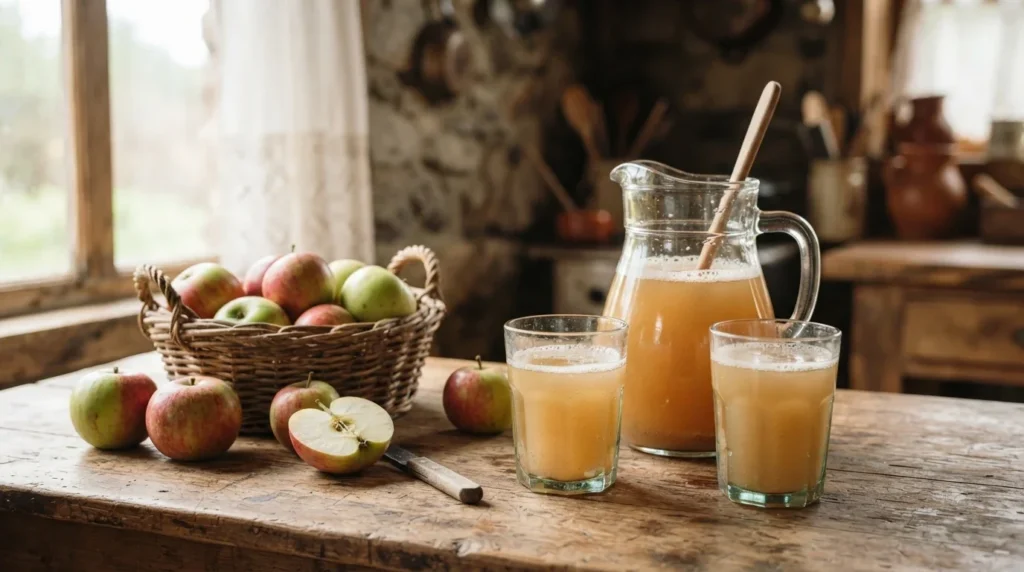
Chicha de manzana, or apple chicha, is fresh apple juice left to ferment naturally with the wild yeasts that live on the fruit's skin. It is the chicha of southern Chile: people drink it sweet after a few days, or wait until it turns "strong" (fuerte). It's simple to make at home. There's no cooking involved: all you need is good apples, very clean equipment and a few days of patience.
Drink responsibly: apple chicha is an alcoholic drink, even when it still tastes sweet, and the alcohol content of a homemade batch can't be known precisely. It is not suitable for minors, pregnant women or anyone who is going to drive.
A drink with deep roots in southern Chile
Chile's Tesauro Regional Patrimonial (a regional heritage thesaurus) describes it as an alcoholic drink typical of southern Chile, especially the Araucanía region and Chiloé, made by hand since colonial times. Historian Amalia Castro San Carlos calls it the signature drink of the Chiloé archipelago. As early as the 17th century, chroniclers and travelers were remarking on how plentiful and good the apples of the south were.
In the Los Ríos region, according to a book on apple chicha and cider published by the Universidad Austral de Chile, a farm was hardly a farm without its apple orchard, and every farmer made chicha for the family and to sell locally. The milling, known in the south as the maja, is a family event held when the fruit ripens, from late summer into autumn. It is a craft passed down from parents and grandparents, using inherited wooden mills and traditional tools such as the dornajo (a wooden trough) and the maja press.
Apple chicha or grape chicha?
When Chileans talk about chicha during the national holidays in September, they usually mean grape chicha, typical of central Chile, such as the one from Curacaví. Apple chicha belongs to the south. Both are fermented fruit musts, but the fruit, the season and the flavor are different: apple chicha is tarter and fresher.
About this recipe
- Home scale: 5 kg (11 lb) of apples for about 2.5 liters, in a kitchen container with no special equipment.
- Natural fermentation: no store-bought yeast. The yeasts on the apple skins do the work.
- Sweet or strong: you choose the point by tasting every day.
- Optional sugar: apples have their own sugar; adding a little is a habit of many home recipes, not a must.
Homemade Chilean apple chicha
Apple chicha made only from fresh apple juice that ferments with the fruit's own wild yeasts, the way it is done in southern Chile. You decide whether to drink it sweet or let it turn strong.
- Prep
- 55 min
- Total
- 55 min
- Resting
- 2 to 7 days of fermentation
- Difficulty
- Easy, but needs cleanliness and patience
- Yield
- 12 glasses of 200 ml (about 2.5 liters)
Ingredients
- 5 kg ripe, sound apples About 30 to 35 medium apples. A mix of sweet and tart works best: use heirloom or farm apples if you can get them; otherwise combine sweet red apples with a few green ones. None rotten or moldy.
- ½ cup sugar (optional) Many home recipes add it for a sweeter, fuller chicha. With very sweet apples you don't need it.
Equipment
- Cutting board and knife
- Juicer (or a coarse grater and a cloth for squeezing)
- Fine strainer and a thin cotton cloth, washed and boiled
- Large bowl
- Glass or food-grade plastic container of about 4 liters, with a wide mouth
- Clean cloth and a rubber band, or a loosely fitting lid
- Long spoon and funnel
- Glass bottles with caps, washed with hot water
Step-by-step method
-
Choose and wash the apples 15 min
Check the apples one by one and set aside any with rotten patches, mold or a bad smell: molds on spoiled fruit can leave toxins that fermentation does not remove. Small bruises can be cut out. Wash the apples under cold running water, rubbing them with your hands, without soap or bleach, and remove stems and leaves. Don't peel them: the natural yeasts that will ferment the chicha live on the skin.
-
Clean everything that will touch the juice 5 min
Wash the fermentation container, strainer, spoon, funnel and bottles with hot water and dish soap, then rinse them very well with hot water until there is no soapy smell. Boil the straining cloth for 5 minutes. Cleanliness is the most important part of this recipe: a dirty container is the most common reason a batch of chicha spoils.
-
Cut the apples 10 min
Cut the apples into quarters or into pieces that fit your juicer's feed tube. If your juicer requires it, remove the cores. Work quickly, or juice as you cut, because cut apple browns when exposed to air.
-
Juice the apples 15 to 20 min
Run the pieces through the juicer and collect the juice in the bowl. It will come out cloudy and foamy, which is normal. If you don't have a juicer, grate the apples with their skin, put the pulp in the cloth and wring it hard, just as the press does in a traditional mill. Five kilos of apples give about 2.5 liters of juice, depending on how juicy the fruit is.
-
Strain into the container 10 min
Strain the juice through the fine strainer lined with the cloth to remove the pulp. Pour it into the fermentation container, filling it only three quarters full: fermentation creates foam and needs room. If you're using sugar, add it now and stir with the clean spoon until no grains remain at the bottom.
-
Cover and let it ferment 1 to 2 days to start
Cover the mouth of the container with the clean cloth held by a rubber band, or rest the lid on top without closing it: the fermentation gas must be able to escape. Leave it in a cool, dark place, ideally between 15 and 20 °C (59 to 68 °F). Within one to two days you'll see fine bubbles rising and a layer of foam on top; the juice has started turning into chicha.
-
Taste daily until it's how you like it 2 to 7 days
Once a day, take a little with a clean spoon and taste it. In the first days it is sweet chicha: mild, still very juice-like and barely tingly. With more days it becomes strong chicha: less sweet, drier and more alcoholic. It should smell of apple and yeast, a bit like bread. If it smells of vinegar, it has gone too far; if mold appears on the surface, throw the whole batch away.
-
Strain again and bottle 15 min
When it tastes the way you like, carefully transfer the chicha into the bottles using the funnel and strainer. Leave behind the lees, the pale sediment of yeast at the bottom of the container. Fill the bottles leaving about 3 cm (1 inch) of headspace and put them in the refrigerator right away.
-
Chill and serve 2 h
Serve the chicha well chilled. Because it keeps fermenting, only more slowly, open the bottles once a day for the first few days to release the gas, always pointing them away from your face. Drink it within one or two weeks: each day it will be a little stronger and more sour.
Substitutions and variations
- Apple varieties: in southern Chile people use heirloom apples such as limona, camuesa, cabrita, rey del invierno or the green Chiloé apple. Outside Chile, mix sweet apples with some tart ones so the chicha doesn't taste flat.
- No sugar: with very ripe, sweet fruit the chicha comes out drier and closer to the one made in the mills.
- Store-bought juice: only 100 % apple juice with no preservatives will do. Since it's pasteurized, it has no live yeasts: you'd have to add yeast, and the result is a different drink.
- Traditional milling: instead of a juicer, you can crush the fruit and press the pulp wrapped in a clean cloth or sack, as in the mills.
Tips for a good batch
- Cleanliness first: the container, strainer and bottles must be spotless. As the chicha maker in the video below puts it, cleanliness is the most important thing.
- A cool spot: warmth speeds up fermentation, but the chicha also turns to vinegar sooner. Between 15 and 20 °C (59 to 68 °F) the process is slower and the flavor cleaner.
- Taste with a clean spoon: never put a spoon you've already tasted from back into the container.
- Write down the days: that way you'll know how long your chicha needs and can repeat it next time.
Common mistakes and how to avoid them
- Using rotten fruit "because it's going to ferment anyway": moldy fruit can carry toxins that fermentation doesn't remove. Always discard spoiled apples.
- Peeling or washing with bleach: this kills the yeasts on the skin and the chicha won't start.
- Sealing the container or bottles at room temperature: fermentation gas builds up and a sealed bottle can burst. Always ferment under a cloth, and keep the bottles in the fridge.
- Filling to the brim: the foam will overflow. Leave at least a quarter of the container empty.
- Leaving it too long: it turns sour and ends up as apple cider vinegar. Taste it every day.
How to store it
Always keep it in the refrigerator, in clean glass bottles. Cold doesn't stop fermentation, it only slows it, so the chicha keeps changing: every day it gets a little less sweet, more sour and slightly more alcoholic. We recommend drinking it within one or two weeks. If a bottle smells of vinegar or shows mold, throw it out. Apple chicha is never heated: it's served cold.
What to serve it with
- With toasted flour: in the Chilean countryside it's customary to stir a spoonful of harina tostada (toasted wheat flour) into the glass.
- At a southern table: it goes well with curanto, shellfish, potatoes or a barbecue.
- With something sweet: sweet chicha pairs nicely with a pound cake, or with quince paste and cheese.
Watch how it's made
In this Spanish-language report by UfroMedios, a chicha maker near Temuco shows the whole process in his workshop: sorting and washing the fruit, milling, pressing, and how the juice becomes chicha from the next day on. It's workshop scale, but the steps are the same as in your kitchen.
Frequently asked questions
How many days does apple chicha need to ferment?
It depends on the temperature and on your taste. At home, in a cool spot, it starts fermenting within one or two days; between the second and fourth day it's usually sweet, and after about a week it becomes strong. Producers leave it for weeks in barrels, but at home scale the safest approach is to bottle and refrigerate it as soon as it tastes the way you want.
How much alcohol does apple chicha have?
For a homemade batch, there's no way to know without measuring it. It depends on the sugar in the fruit, any added sugar and the days of fermentation. For reference, ciders usually range from 2 % to 8 % alcohol. Sweet chicha has less, strong chicha more.
What's the difference between apple chicha and cider?
Both come from fermented apple juice. Chicha is the country version: a short, natural fermentation, drunk young, sometimes sweet and cloudy. Cider goes through a longer, more controlled fermentation and is usually bottled clear and sparkling. In southern Chile many producers make both, along with vinegar.
What is "strong" chicha?
It's chicha that was left to ferment longer, until the yeasts consumed much of the sugar. It's less sweet, drier and more alcoholic. Sweet chicha, on the other hand, is drunk after just a few days, while it still tastes of the juice.
Why isn't my chicha fermenting?
The usual causes are peeling the apples, washing them with bleach or keeping the container somewhere too cold. Move it to a slightly warmer place and wait another day. If you used pasteurized store-bought juice, it has no live yeasts and won't ferment on its own.
Why does my chicha taste like vinegar?
Because it fermented too long, too warm or with too much contact with air. At the end of fermentation, other bacteria turn the alcohol into acetic acid, which is vinegar. It can't be undone: next time, taste it sooner and refrigerate it as soon as you like it.
Nutrition information
We don't publish a nutrition table because the sugar and alcohol in homemade chicha vary with the fruit and the days of fermentation, and there is no reliable data to give figures.
Sources
- Tesauro Regional Patrimonial, «chicha de manzana» (Spanish).
- Paola Segovia and Carmengloria Benavides, Chicha y sidra de manzanas: patrimonio de la región de Los Ríos, Universidad Austral de Chile (Spanish).
- Amalia Castro San Carlos et al., «Chicha de manzana de Chiloé: historia épica de un producto típico, siglos XIX-XX», Revista Estudios Hemisféricos y Polares, 2018 (Spanish, English abstract).
- Pauta, ¿Cómo es el proceso de producción de la chicha? (2022, Spanish).
- Cabalgatas Chile, Chicha de manzana (Spanish).
- Comidas Chilenas, Receta de chicha de manzana (Spanish; apple varieties and sugar ratio).
- UfroMedios, Elaboración de chicha de manzana (YouTube, 2021, Spanish).
Leave a Reply